
 By
By Health
Why stress can make your hair fall out
And what it might tell researchers about autoimmune disease
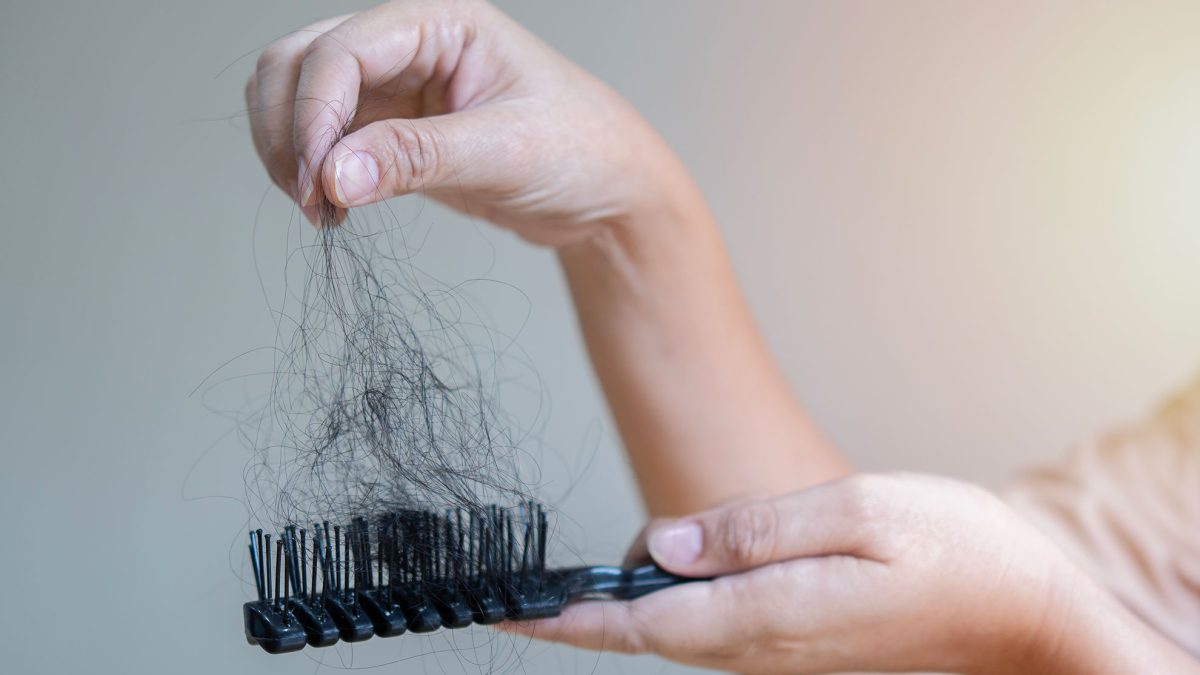
It’s well known that stress can trigger hair loss. A new paper explores how this happens and how our response to stress can have long-term consequences for our scalps, research that may eventually yield insights into autoimmune diseases.
In research published in Cell, Ya-chieh Hsu, professor of stem cell and regenerative biology, and her lab found that the hair loss resulted from a two-part reaction.
The first part, the immediate loss of hair, was simple. “Stress has an immediate impact through the activation of the sympathetic nervous system,” explained Hsu, who is also a principal faculty member of the Harvard Stem Cell Institute.
She said that it begins with our natural “fight or flight” response, which releases norepinephrine, a neurotransmitter that — among other effects — kills highly proliferating cells in the hair follicle when the level is too high.
Hair loss in such circumstances is usually temporary.
Ya-Chieh Hsu, a professor of stem cell and regenerative biology.
Photos by Veasey Conway/Harvard Staff Photographer
Postdoctoral fellows on Hsu’s lab include Emily Scott-Solomon (from left), Shlomi Brielle, and Alexander Mann.
“Because stem cells are spared in this case, you could regenerate the hair follicle, so you will have temporal hair loss, but then your stem cells are going to get activated to regenerate new hair,” said Hsu.
However, imaging by co-author H. Amalia Pasolli, an electromicroscopy biologist, revealed additional, more far-reaching details. The Rockefeller University professor found that the hair follicles that had been killed by the norepinephrine “looked like hydrochloric acid had been poured on them” and had died by necrosis, said Emily Scott-Solomon, a postdoc in Hsu’s lab who led the work.
This surprising finding prompted Scott-Solomon to take a closer look at the tissue, leading to the discovery of a secondary reaction.
Following the release of norepinephrine, the researchers found, the body perceives inflamed or necrotic tissue as a hostile invader.
That, in turn, triggers a “cascade” of immune reactions to activate autoreactive CD8+ T cells, according to Hsu. These T cells, which typically work to protect healthy cells, “now see hair follicles as a foreign object they should attack,” she said.
Courtesy of Hsu Lab
This secondary attack can have lingering effects, as the overreactive T cells can trigger recurrent autoimmune attacks on the hair follicle when additional stressors occur.
That possibility has opened avenues of exploration to understand other autoimmune diseases, such as Type 1 diabetes, lupus, or multiple sclerosis. With autoimmune diseases, Hsu said, “You always need a trigger, and the trigger is not necessarily genetics.”
Because of its broad range, she continued, such work requires considerable cross-disciplinary collaboration.
Her three co-first authors on this paper include postdocs Scott-Solomon, who trained as a neurobiologist; Shlomi Brielle, who handled bioinformatic analyses; and Alexander Mann, an immunologist.
Hsu also credited Dana Farber Cancer Institute’s Judith Agudo, an expert in immune attack and tolerance, as a crucial collaborator.
“A study like this is important both for its findings and for how it was conducted,” said Mann, who works in the Department of Stem Cell and Regenerative Biology and Department of Immunology at the Harvard Medical School lab of Assistant Professor Ruth Franklin, an expert on inflammation and another key contributor.
“First, it is really a great example of interdisciplinary collaboration, bringing together neuroscience, stem cell biology, and immunology. It highlights how much new biology can be discovered when researchers with different expertise work together,” Mann said. “On the immunology side, this study demonstrates one way that autoimmune diseases can be triggered and raises many more questions about the causes of autoimmunity.”
The impact of our lived experiences on our bodies is a topic that has long entranced Hsu, who is also involved in the Biology of Adversity project at the Broad Institute, which looks at how adverse experiences reshape our tissues and drive disease.
“My lab has been really fascinated by how our experiences in this world regulate tissue,” said Hsu, noting their other ongoing studies on the impact of stressors on the body, such as what role external stressors have in recurrent T-cell attacks.
“I find it fascinating to see that how we live our life has the same impact on our tissues as many of our genes,” said Hsu. “In stem cell and tissue biology, we tend to focus heavily on the genes we carry.”
Equally important, she points outs, “is to think about how lifestyle and stress shape us.”
This research was partially supported by the National Institutes of Health, including awards from the National Institute of Arthritis and Musculoskeletal and Skin Diseases, the National Cancer Institute, and the National Institute of Diabetes and Digestive and Kidney Diseases.
It’s well known that stress can trigger hair loss. A new paper explores how this happens and how our response to stress can have long-term consequences for our scalps, research that may eventually yield insights into autoimmune diseases.
In research published in Cell, Ya-chieh Hsu, professor of stem cell and regenerative biology, and her lab found that the hair loss resulted from a two-part reaction.
The first part, the immediate loss of hair, was simple. “Stress has an immediate impact through the activation of the sympathetic nervous system,” explained Hsu, who is also a principal faculty member of the Harvard Stem Cell Institute.
She said that it begins with our natural “fight or flight” response, which releases norepinephrine, a neurotransmitter that — among other effects — kills highly proliferating cells in the hair follicle when the level is too high.
Hair loss in such circumstances is usually temporary.
Ya-Chieh Hsu, a professor of stem cell and regenerative biology.
Photos by Veasey Conway/Harvard Staff Photographer
“Because stem cells are spared in this case, you could regenerate the hair follicle, so you will have temporal hair loss, but then your stem cells are going to get activated to regenerate new hair,” said Hsu.
However, imaging by co-author H. Amalia Pasolli, an electromicroscopy biologist, revealed additional, more far-reaching details. The Rockefeller University professor found that the hair follicles that had been killed by the norepinephrine “looked like hydrochloric acid had been poured on them” and had died by necrosis, said Emily Scott-Solomon, a postdoc in Hsu’s lab who led the work.
This surprising finding prompted Scott-Solomon to take a closer look at the tissue, leading to the discovery of a secondary reaction.
Following the release of norepinephrine, the researchers found, the body perceives inflamed or necrotic tissue as a hostile invader.
That, in turn, triggers a “cascade” of immune reactions to activate autoreactive CD8+ T cells, according to Hsu. These T cells, which typically work to protect healthy cells, “now see hair follicles as a foreign object they should attack,” she said.
Courtesy of Hsu Lab
This secondary attack can have lingering effects, as the overreactive T cells can trigger recurrent autoimmune attacks on the hair follicle when additional stressors occur.
That possibility has opened avenues of exploration to understand other autoimmune diseases, such as Type 1 diabetes, lupus, or multiple sclerosis. With autoimmune diseases, Hsu said, “You always need a trigger, and the trigger is not necessarily genetics.”
Because of its broad range, she continued, such work requires considerable cross-disciplinary collaboration.
Her three co-first authors on this paper include postdocs Scott-Solomon, who trained as a neurobiologist; Shlomi Brielle, who handled bioinformatic analyses; and Alexander Mann, an immunologist.
Hsu also credited Dana Farber Cancer Institute’s Judith Agudo, an expert in immune attack and tolerance, as a crucial collaborator.
“A study like this is important both for its findings and for how it was conducted,” said Mann, who works in the Department of Stem Cell and Regenerative Biology and Department of Immunology at the Harvard Medical School lab of Assistant Professor Ruth Franklin, an expert on inflammation and another key contributor.
“First, it is really a great example of interdisciplinary collaboration, bringing together neuroscience, stem cell biology, and immunology. It highlights how much new biology can be discovered when researchers with different expertise work together,” Mann said. “On the immunology side, this study demonstrates one way that autoimmune diseases can be triggered and raises many more questions about the causes of autoimmunity.”
The impact of our lived experiences on our bodies is a topic that has long entranced Hsu, who is also involved in the Biology of Adversity project at the Broad Institute, which looks at how adverse experiences reshape our tissues and drive disease.
“My lab has been really fascinated by how our experiences in this world regulate tissue,” said Hsu, noting their other ongoing studies on the impact of stressors on the body, such as what role external stressors have in recurrent T-cell attacks.
“I find it fascinating to see that how we live our life has the same impact on our tissues as many of our genes,” said Hsu. “In stem cell and tissue biology, we tend to focus heavily on the genes we carry.”
Equally important, she points outs, “is to think about how lifestyle and stress shape us.”
This research was partially supported by the National Institutes of Health, including awards from the National Institute of Arthritis and Musculoskeletal and Skin Diseases, the National Cancer Institute, and the National Institute of Diabetes and Digestive and Kidney Diseases.